
2026 Travel Insurance Guide: How to Choose, Costs & Claims Process Explained
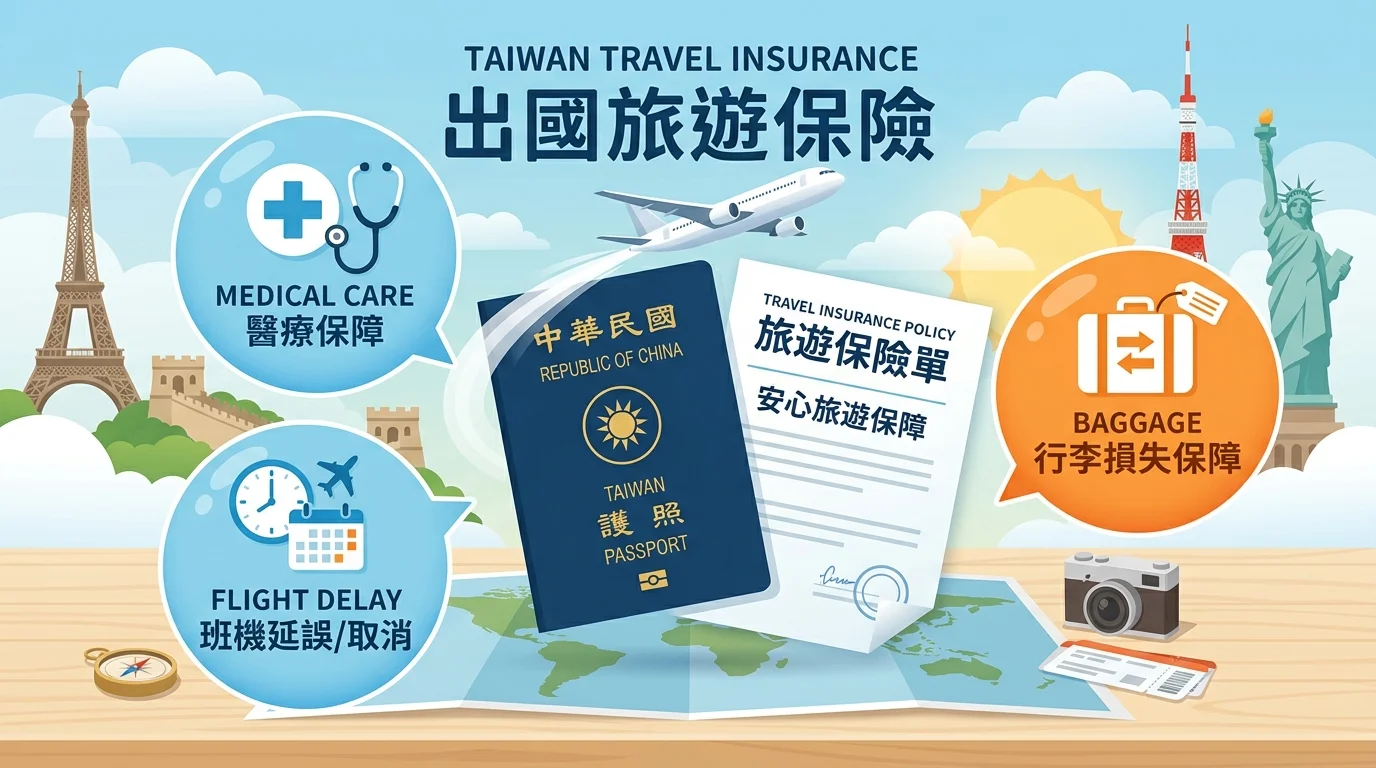
Do you know how much an emergency room visit abroad might cost? Overseas medical costs are often far higher than in Taiwan, and if you end up needing a hospital stay, the bill can easily blow your entire travel budget. Without travel insurance, you're gambling your savings against fate.
This article helps you understand travel insurance from scratch: how to choose a plan, approximate premiums, what to prepare for claims, plus real Dcard user recommendations and cautionary tales. After reading, you'll be able to complete your coverage in 10 minutes and depart with peace of mind.
TL;DR: We recommend buying your own travel insurance — travel agency coverage is limited. Premiums depend on destination, trip length, age and coverage scope — go by each insurer's online quote. Before purchasing, confirm destination requirements, choose coverage types, and compare at least 3 providers. Claims require receipts and documentation from the incident, and the insurer must pay within 15 days of receiving the complete documents.
Overseas Medical Care Is Costly, Travel Insurance Premiums Keep Rising — Traveling Uninsured Is Extremely Risky
Overseas medical costs are shockingly high. Without insurance, a minor cold that turns into hospitalization could double your travel budget. Figures from Taiwan's Insurance Bureau (FSC) show travel accident insurance premiums of NT$4.8 billion in 2024, and NT$5.04 billion in just the first 11 months of 2025 — already more than the whole previous year (United Daily News, 2026).
Many people assume their travel agency already bought insurance that's sufficient. Not quite.
Travel Agency Insurance vs Personal Insurance: What's the Difference?
Travel agencies mainly provide "performance guarantee insurance" and "liability insurance." Simply put, performance guarantee insurance covers you when the agency goes bankrupt or cancels the tour — you can recover your tour fees. Liability insurance covers injuries caused by the agency's arrangement errors.
But your own sudden stomachache requiring an ER visit? Flight delay costing an extra hotel night? Luggage lost during transfer? None of these are covered by travel agency insurance.
Personal travel insurance covers:
- Overseas emergency medical treatment: Colds, gastroenteritis, injuries, consultations and hospitalization
- Accident injury coverage: Disability or death from accidents
- Flight delay compensation: Extra accommodation, dining, and transportation costs
- Lost luggage compensation: Compensation for delayed or lost luggage
After comparing various plans, we found travel agency coverage typically only meets minimum thresholds, with significant gaps compared to personal insurance. The safest approach is combining both: agency baseline + your own comprehensive coverage.
Travel Agency Performance Guarantee Insurance Explained
Under Article 66 of the Tourism Administration's Regulations Governing Travel Agencies, travel agencies must carry "performance guarantee insurance," and the minimum insured amount is set for the company as a whole: NT$100 million for comprehensive travel agencies and NT$30 million for Class A agencies (reduced to NT$80 million and NT$15 million respectively for members of a tourism public-interest association) — it is not a per-traveler amount. But this money only pays out when the agency fails to fulfill its contract (e.g., bankruptcy) — completely unrelated to your personal medical emergencies.
Even if your travel agency arranges other insurance on your behalf, we still recommend checking what it covers before departure and buying your own supplemental policy if it falls short.
After securing insurance, don't forget to compare accommodation prices — hotel deals are compiled at the end of this article.
2026 Recommended Travel Insurance Providers: Plan Comparison
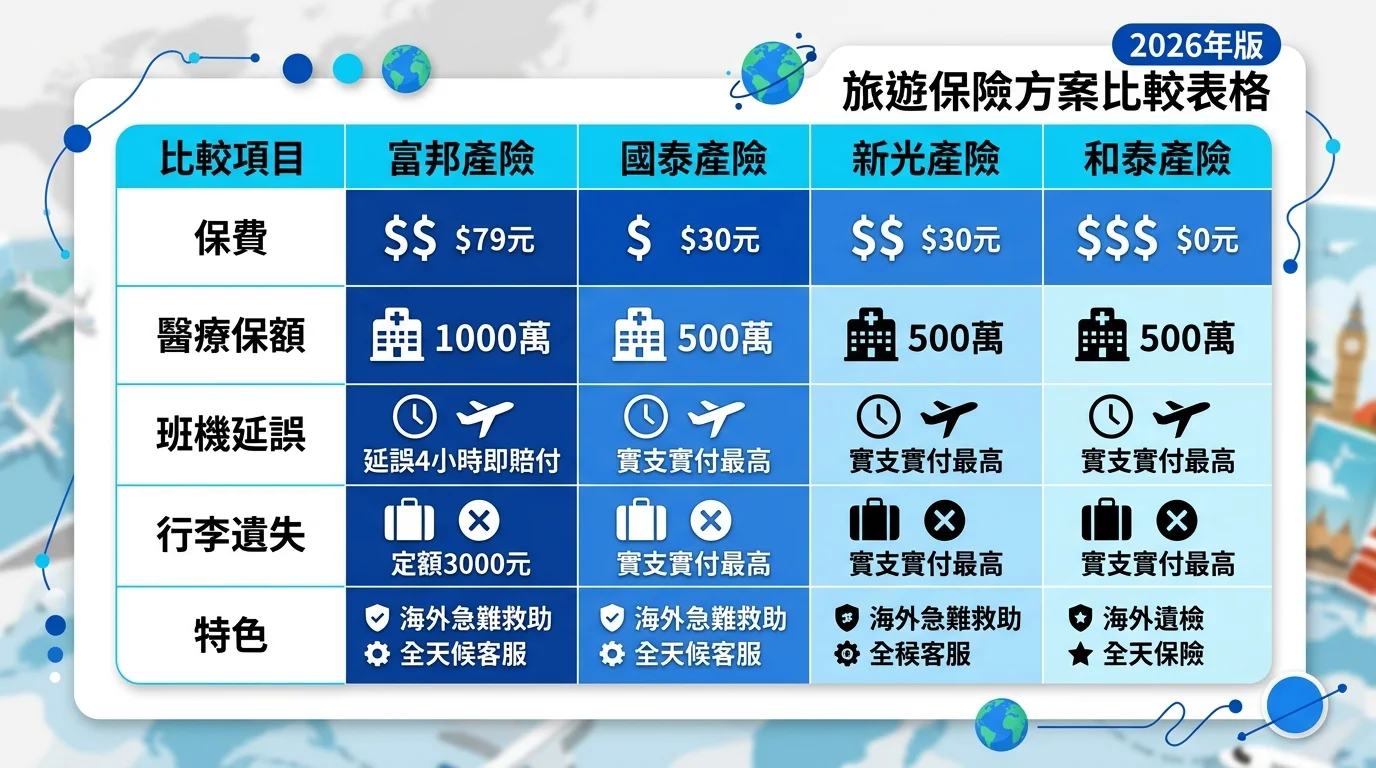
Quite a few property insurance companies currently offer travel insurance plans, and premiums and coverage differ from one to the next. We've put together the key comparison points for the mainstream providers — for actual premiums and coverage amounts, go by each company's online quote.
Provider Plan Comparison (Costs & Coverage)
| Insurance Company | Asia 5-Day Premium | Europe/Americas 10-Day Premium | Medical Coverage | Flight Delay | Lost Luggage |
|---|---|---|---|---|---|
| Cathay Century | See official online quote | See official online quote | Varies by plan | Yes | Yes |
| Fubon Insurance | See official online quote | See official online quote | Varies by plan | Yes | Yes |
| Shin Kong Insurance | See official online quote | See official online quote | Varies by plan | Yes | Yes |
| MSIG Mingtai | See official online quote | See official online quote | Varies by plan | Yes | Some plans |
Actual premiums and coverage amounts vary by age, trip length and coverage details. Verify with each company's website before purchasing.
Dcard Users' Most Recommended Travel Insurance Plans
We compiled Dcard travel board insurance discussions from the past six months, identifying key points:
- Most recommended: Cathay and Fubon online plans, mainly because "claims are fast" and "online operation is convenient"
- Common complaints: Some plans require 6+ hour delays before qualifying for claims — most delays are 2-4 hours, making coverage useless
- PTT/Dcard consensus: Don't just look at cheap premiums — claim conditions and exclusions are what matter
One user shared getting food poisoning in Japan, hospitalized for 2 days, with travel insurance covering the medical expenses. Another complained about a provider taking 2 months to process a claim. So choosing insurance isn't just about price — claims efficiency matters too.
How Are Travel Insurance Premiums Calculated? 5 Key Factors
Travel insurance premiums aren't a fixed number. Five factors affect pricing:
- Destination: Europe/Americas cost more than Asia due to higher local medical costs
- Trip duration: Longer trips = higher premiums, but not proportionally
- Age: Premiums are adjusted by the insured person's age — older travelers should compare each insurer's rates before buying
- Coverage scope: Medical only vs medical + accident + delay + luggage — a sizeable price difference
- Trip cancellation add-on: Adds an extra premium; the amount depends on the plan
For the actual premium, go by each company's online quote. Premiums aren't high, but they can save you a fortune when it matters.
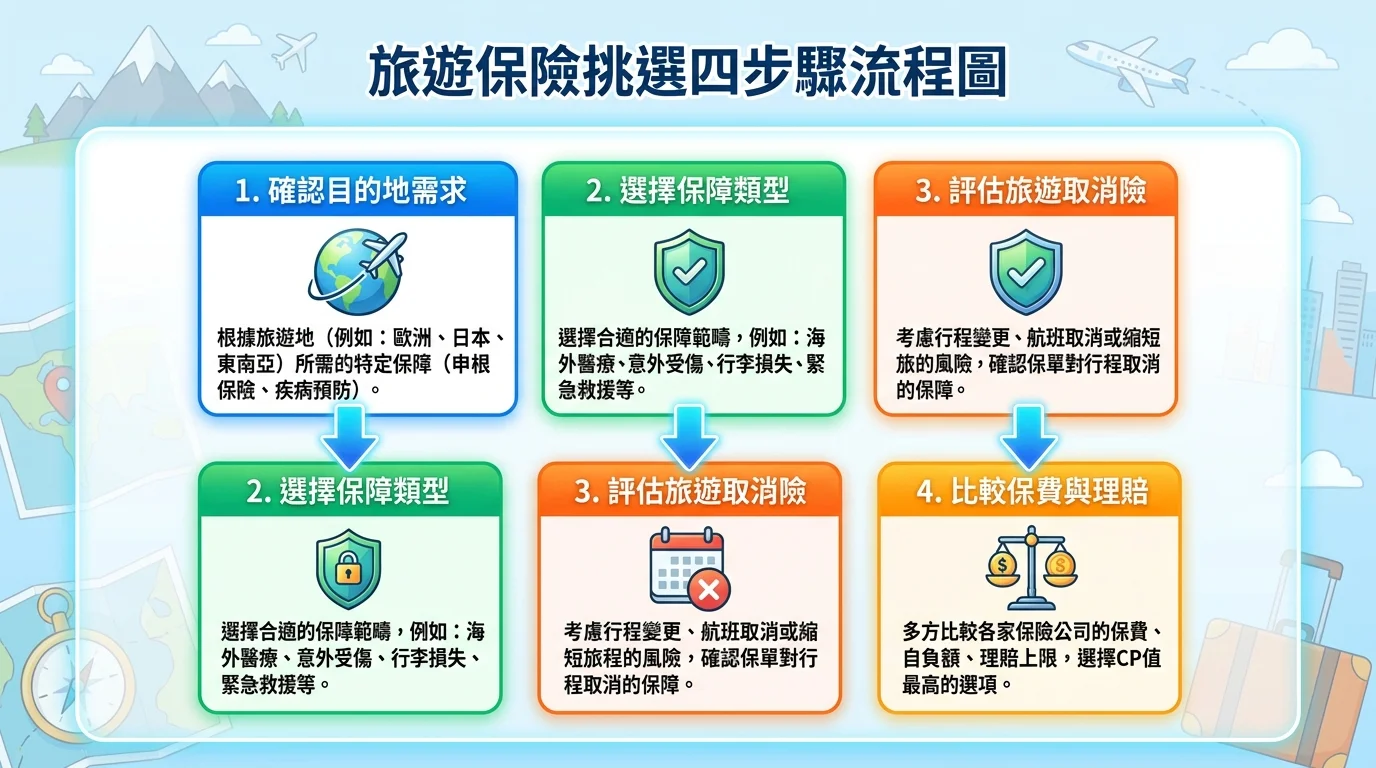
How to Pick Travel Insurance: 4 Steps to the Right Coverage
Don't want to spend too much time studying insurance terms? Follow these 4 steps.
Step 1: Confirm Destination Requirements
Different destinations have very different insurance needs:
- European Schengen countries (29 of them): the €30,000 (~NT$1 million) minimum is a requirement for applying for a Schengen visa. Taiwanese passport holders get 90 days visa-free and file no application, so it is not legally mandatory — but Taiwan's foreign ministry and the European offices in Taipei all strongly recommend it, and border officers may ask to see it. Europe-bound travelers, see → Europe Travel Insurance Complete Guide
- Asia (Japan, Korea, Southeast Asia): No mandatory requirement, but medical costs aren't cheap — recommend at least NT$500K coverage. Korea travel insurance guide → Korea Travel Insurance Guide
- Americas: Highest medical costs globally — recommend coverage of NT$2 million+
Step 2: Choose Coverage Types
Medical insurance is the baseline — virtually everyone needs it. Other coverage depends on your travel style:
| Coverage Type | Best For | Recommendation |
|---|---|---|
| Overseas Medical | Everyone | Must-have |
| Accident Injury | Outdoor activity participants | Strongly recommended |
| Flight Delay | Multi-connection flights, winter travel | Recommended add-on |
| Lost Luggage | Itineraries with multiple transfers | Optional add-on |
Step 3: Should You Add Trip Cancellation Insurance?
Trip cancellation insurance covers: when illness, family emergencies, or force majeure prevents departure, you can recover already-paid flight and accommodation costs.
Best for:
- High-cost trips (long European trips, tours over NT$50,000)
- Unstable health conditions that might prevent travel
- Traveling with young children or elderly parents
Add-on cost depends on the plan — get a quote before you buy. But note: some plans only cover "unforeseeable" reasons. If you already know you might cancel but still purchase coverage, it won't pay out.
Step 4: Compare Premiums and Claim Limits
Same coverage, different providers — premiums can vary considerably. Compare at least 3 providers before deciding.
One often-overlooked detail: some cheap-looking plans have much lower claim limits. Take flight delays — the delay threshold that triggers a payout and the claim cap both differ from plan to plan, so compare them alongside the premium before you buy.
Online comparison platforms (like SARAcares, Finfo) let you view multiple plans at once, saving individual research time.
How Does the Travel Insurance Claims Process Work?
The insurer must pay within 15 days of receiving the complete claim documents (with interest added if it is late), so speed mainly depends on when your documents are complete. Buying insurance is just the first step — do you know how to file a claim if you actually need to?
How Long Until Claim Payment?
Policy terms state that the insurer must pay within 15 days of receiving the complete claim documents; if it is late for reasons attributable to the insurer, it must add interest at 10% a year (Taian Insurance overseas travel accident policy terms). So speed mainly depends on when your documents are complete:
| Case Type | Documents to Prepare First |
|---|---|
| Flight delay | Delay certificate issued by the airline |
| Lost luggage | Airline's lost-baggage report |
| Outpatient or inpatient medical | Medical certificate and receipts |
Complete documentation is the key to faster claims.
Required Documents Checklist
Develop a habit of "saving receipts" while abroad so you're not scrambling afterward:
- All cases: Policy number, passport copy (with entry/exit records), claim application form
- Medical claims: Original medical receipts, diagnosis certificate (English preferred), prescriptions
- Flight delay: Airline delay certificate, accommodation/dining receipts incurred by delay
- Lost luggage: Airline Property Irregularity Report (PIR), list of bag contents with value documentation
Tip: Many insurers require "original" receipts — having only copies or digital versions may trigger supplemental document requests, delaying claims. Keep receipts immediately after medical visits.
Common Claim Denials and How to Avoid Them
No one wants a denied claim, but it happens. Common reasons:
- Undisclosed pre-existing conditions: Hiding known chronic conditions at time of purchase — insurer discovers and denies
- Uninsured high-risk activities: Skiing, diving, rock climbing may not be covered under standard plans
- Missed claim deadline: Most companies require filing within 2 years of incident — don't wait too long
- Drink-driving accidents: Accidents while driving or riding after drinking, with a blood or breath alcohol level above the local legal limit, are not covered
- War zones or terrorist attack areas: Incidents in red-alert travel warning zones are typically excluded
Simplest way to avoid denials: honestly fill out health declarations, read exclusion clauses carefully, keep all documents while abroad.

Special Groups: What to Watch For
Different groups have different insurance considerations. Parents traveling with kids or elderly parents — pay special attention.
Insurance for Family Travel with Kids
Traveling abroad with children requires special attention:
- Under Article 107 of the Insurance Act (applied to accident insurance via Article 135), if an insured child dies before turning 15, only a funeral expense benefit can be paid, currently capped at NT$690,000 — this is legally mandated, same across all providers
- Good news: medical coverage isn't subject to this limit — you can insure kids for the same medical amount as adults
- Children have weaker immune systems — diarrhea, fever, and altitude sickness are most common abroad. Medical coverage must be sufficient
More on traveling with kids and insurance → Family Travel Insurance Guide
Senior Travelers (60+) Insurance Restrictions
Children planning trips for their parents — insurance may be more complicated than expected:
- 60-69: Premiums are adjusted by age, most companies still accept normal applications
- 70-79: Available plans decrease noticeably, some coverage caps reduced, and premiums are likewise adjusted by age
- 80+: Very few companies offer coverage, with more basic protection
Planning trips for elderly parents → Senior Travel Insurance Guide
Traveling with Kids? Choosing the Right Hotel Matters Too
Beyond insurance, picking the right accommodation matters for family trips. Family hotels with playrooms and kids' amenities make parents' lives much easier.
Half-Board Plans | Best Value Accommodation + Dining
Do You Still Need COVID-19 Coverage?
Whether COVID-19 and other notifiable infectious diseases are covered depends on the policy: some products already include them under overseas sudden-illness cover, while others exclude them or require an add-on (Commercial Times, 2026). For example, Taian Insurance's overseas travel policy lists "infectious diseases as defined in Article 3 of the Communicable Disease Control Act, unless otherwise agreed in the contract" among its sudden-illness exclusions.
Before buying, check the policy's exclusions to see whether notifiable infectious diseases are covered, then decide whether you need an add-on.
Travel Insurance FAQ
Q: Is travel insurance mandatory for international trips?
A: "Insurance is mandatory for Schengen countries" is a common misreading — that rule belongs to the Schengen visa application, and visa-free Taiwanese travellers are not legally bound by it (though it is strongly recommended). Other destinations have no requirement either. However, overseas medical costs are extremely high, and a travel insurance policy prevents unexpected expenses from exploding your travel budget. We strongly recommend coverage regardless of destination.
Q: How long do travel insurance claims take?
A: Under the policy terms, the insurer must pay within 15 days of receiving the complete claim documents, with interest added if it is late. How fast you get paid mainly depends on when your documents are complete — complete documentation is the key to faster processing.
Q: How much does travel insurance cost?
A: There's no fixed figure — go by each company's online quote. Factors include destination, duration, age, coverage scope, and trip cancellation add-on.
Q: My travel agency already bought insurance — do I still need my own?
A: Travel agencies provide "performance guarantee" and "liability" insurance, mainly covering agency failures to fulfill contracts. They don't cover your personal overseas medical, flight delays, or lost luggage. We recommend supplementing with personal travel insurance for complete coverage.
Q: Is trip cancellation insurance worth adding?
A: If trip costs exceed NT$50,000, you're traveling with young children or elderly parents, or health conditions are unstable — yes, add it. The add-on cost depends on the plan, and it covers flight and accommodation losses from unforeseeable cancellation reasons.
Travel Smart: Insurance Sorted, Now Book Accommodation Wisely
Insurance is done — now figure out where to stay. Whether you're planning a domestic mini-trip after returning from abroad, or simply wanting a family weekend getaway, saving on accommodation always helps.
Honestly, accommodation is the biggest chunk of travel spending. Instead of comparing prices everywhere until your head hurts, go straight to a platform with pre-negotiated low prices.

Further Reading
- Europe Travel Insurance Complete Guide
- Korea Travel Insurance Guide
- Family Travel Insurance Guide
- Senior Travel Insurance Guide
- Credit Card Hotel Deals Guide
References
- Tourism Administration — Travel Industry Management Regulations
- Financial Supervisory Commission — Travel Insurance Regulations
- Insurance Act Article 107 — Insured Persons Under 15 Death Benefit Limit