
[2026] Complete Guide to Taiwan Hot Springs | Distribution Map, Spring Types & Well-Known Hot Spring Areas
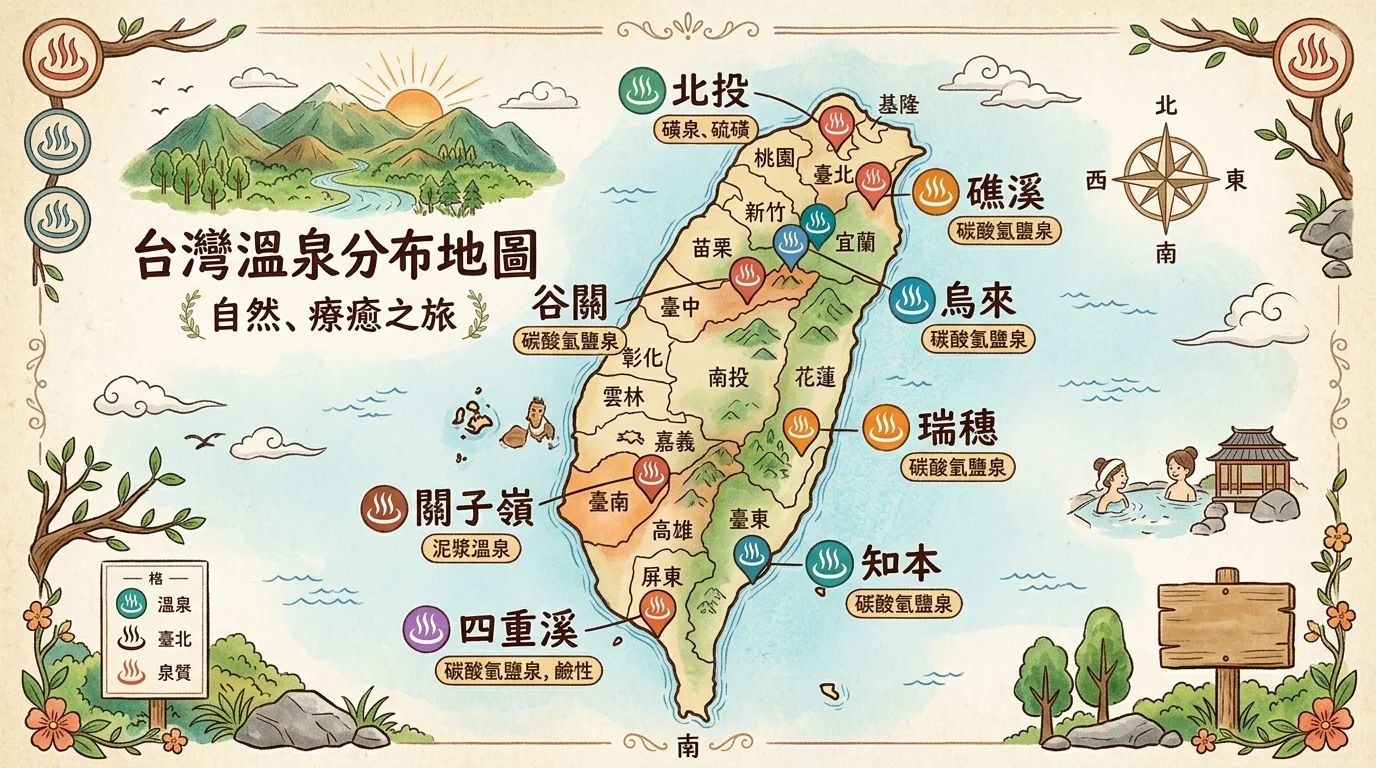
Did you know Taiwan has more than a hundred known hot spring sites? From Beitou — just 30 minutes from Taipei city — to Ruisui in Hualien requiring a train and transfer, each hot spring area offers completely different spring quality, scenery, and experience. Which hot spring is most unique? What's the difference between sodium bicarbonate and sulfur springs?
This article covers everything about Taiwan hot springs. Maps, spring types, history, seasonal events — read this and you'll be the hot spring expert among your friends.
Done learning about Taiwan hot springs and ready to book? Cool Price Travel hot spring hotels from 80% off
TL;DR: Taiwan has more than a hundred known hot spring sites, with four main spring types: sodium bicarbonate (Jiaoxi beauty spring), sulfur (Beitou), carbonated (Tai'an), and mud spring (Guanziling — rare in Taiwan). The four great hot springs of the Japanese colonial era were Beitou, Yangmingshan, Guanziling, and Sichongxi. Autumn and winter are the best seasons for soaking.
👉 花蓮潔西艾美渡假酒店 stay packages → View plan
Why Does Taiwan Have So Many Hot Springs? Tectonic Plates & Geothermal Origins
Taiwan has more than a hundred known hot spring sites, and the Tourism Administration describes Taiwan as "one of the best spring-quality regions in the world" (Tourism Administration, MOTC). Across the whole of 2025, hotel guests in Taiwan reached 82.09 million; domestic guests numbered 61.329 million, up about 9.8 million from 51.53 million in pre-pandemic 2019 (Tourism Administration Statistics, 2025; Tourism Administration, MOTC, 2026). Hot spring tourism is a major driver of the domestic travel market.
Geological Origins
Simply put: tectonic plate compression. Taiwan sits at the boundary of the Eurasian and Philippine Sea plates, part of the Pacific Ring of Fire. The collision creates intense crustal activity and abundant geothermal resources.
The varying directions and forces of plate compression across different areas account for Taiwan's remarkably diverse spring types. Beitou has sulfur springs due to the Datun volcanic group, while Jiaoxi has sodium bicarbonate springs from groundwater heated in specific rock formations. Same island, completely different hot spring experiences — rare anywhere in the world.
Taiwan Hot Spring Brief History
Taiwan's hot spring culture dates back to the Japanese colonial period (1895-1945). The Beitou hot springs were first discovered back in 1894 by a German named Quely; during the Japanese period the Japanese began building bathhouses and inns (the first hot spring inn, Tengu-an (天狗庵), opened in 1896), laying the foundation for "Beitou Hot Spring." Yangmingshan, Guanziling, and Sichongxi were subsequently developed, forming the four most renowned hot springs of the Japanese era: Beitou, Yangmingshan, Guanziling, and Sichongxi. The 2003 Hot Spring Act formalized management with water quality testing and operator certification.
Where Are Taiwan's Hot Springs? Full Island Distribution
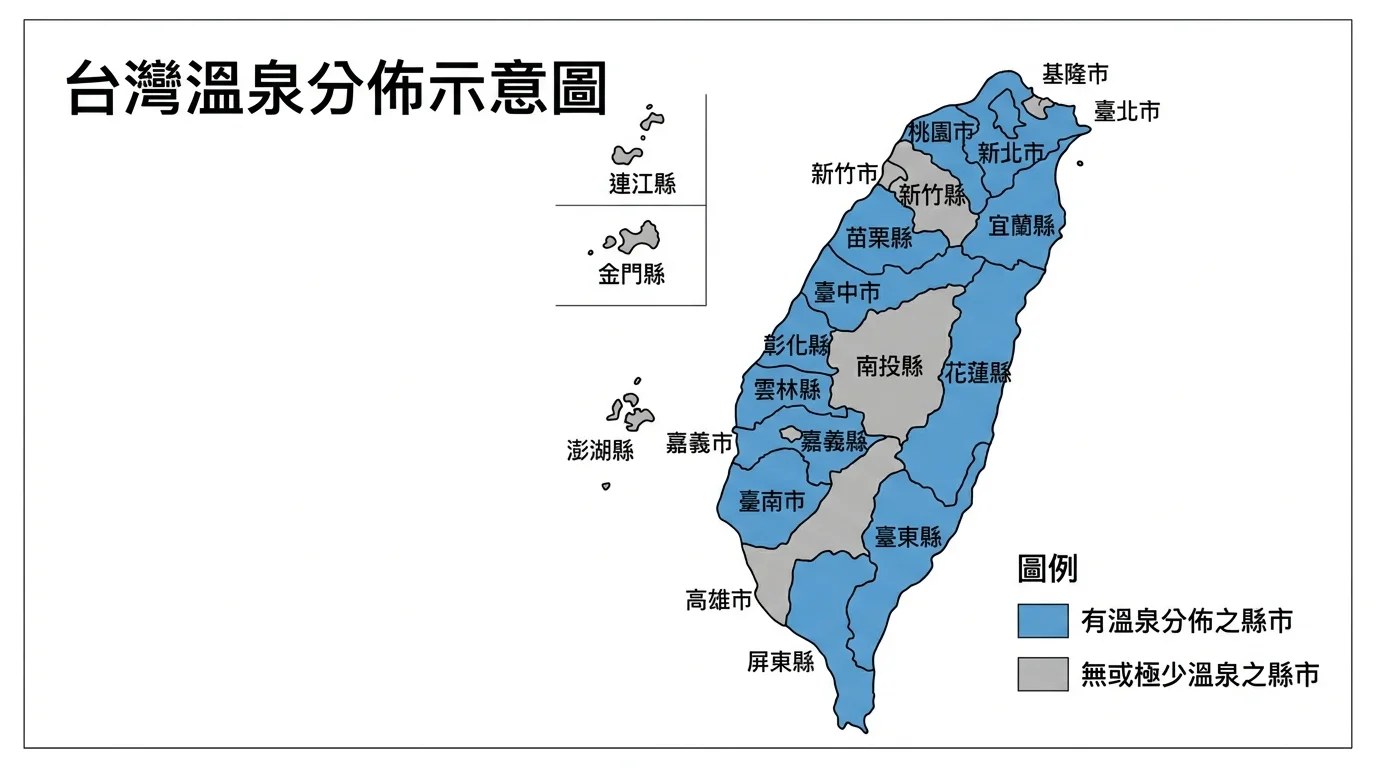
Northern Hot Spring Areas (Beitou, Wulai, Jiaoxi, Jinshan-Wanli)
- Beitou: White sulfur + green sulfur springs, MRT accessible
- Wulai: Sodium bicarbonate spring, Atayal indigenous culture
- Jiaoxi: Sodium bicarbonate spring (beauty spring), a flatland hot spring rare in Taiwan
- Jinshan-Wanli: Sulfur spring + undersea hot spring, north coast scenery bonus
Northern hot springs are the most accessible — day trips from Taipei to any hot spring area.
Central Hot Spring Areas (Guguan, Tai'an, Lushan)
- Guguan: Sodium bicarbonate spring, mountain forest retreat at Central Cross-Island Highway entrance
- Tai'an: Carbonated spring, Miaoli mountain town
- Lushan: Carbonated spring, but the zone has been formally decommissioned as geologically unsafe and is not recommended
Central hot springs are mostly in mountain areas — self-driving is most convenient.
Southern Hot Spring Areas (Guanziling, Sichongxi, Baolai-Bulao)
- Guanziling: Mud spring, rare in Taiwan
- Sichongxi: Carbonated spring, one of the four great hot springs of the Japanese era, seasonal light displays
- Baolai-Bulao: Sodium bicarbonate spring, Kaohsiung wild hot spring
Southern hot springs have distinctive spring quality — mud springs are quite rare in Taiwan and worth a dedicated trip.
Eastern Hot Spring Areas (Zhiben, Ruisui, Antong, Jioujhihze)
- Zhiben: Sodium bicarbonate spring, Taitung forest-style hot spring
- Ruisui: Two spring types, sodium bicarbonate and iron-bearing carbonate; the latter turns golden as it oxidizes, hence the nickname "golden spring"
- Antong: Weakly alkaline carbonated spring, Hualien Yuli hidden gem
- Jioujhihze: Sodium bicarbonate spring, Taipingshan hot spring egg cooking
Eastern hot springs have the most beautiful scenery with a hidden gem atmosphere.
See hot spring hotel recommendations by region: Regional Hot Spring Hotel Recommendations.
What Spring Types Does Taiwan Have? Complete Analysis
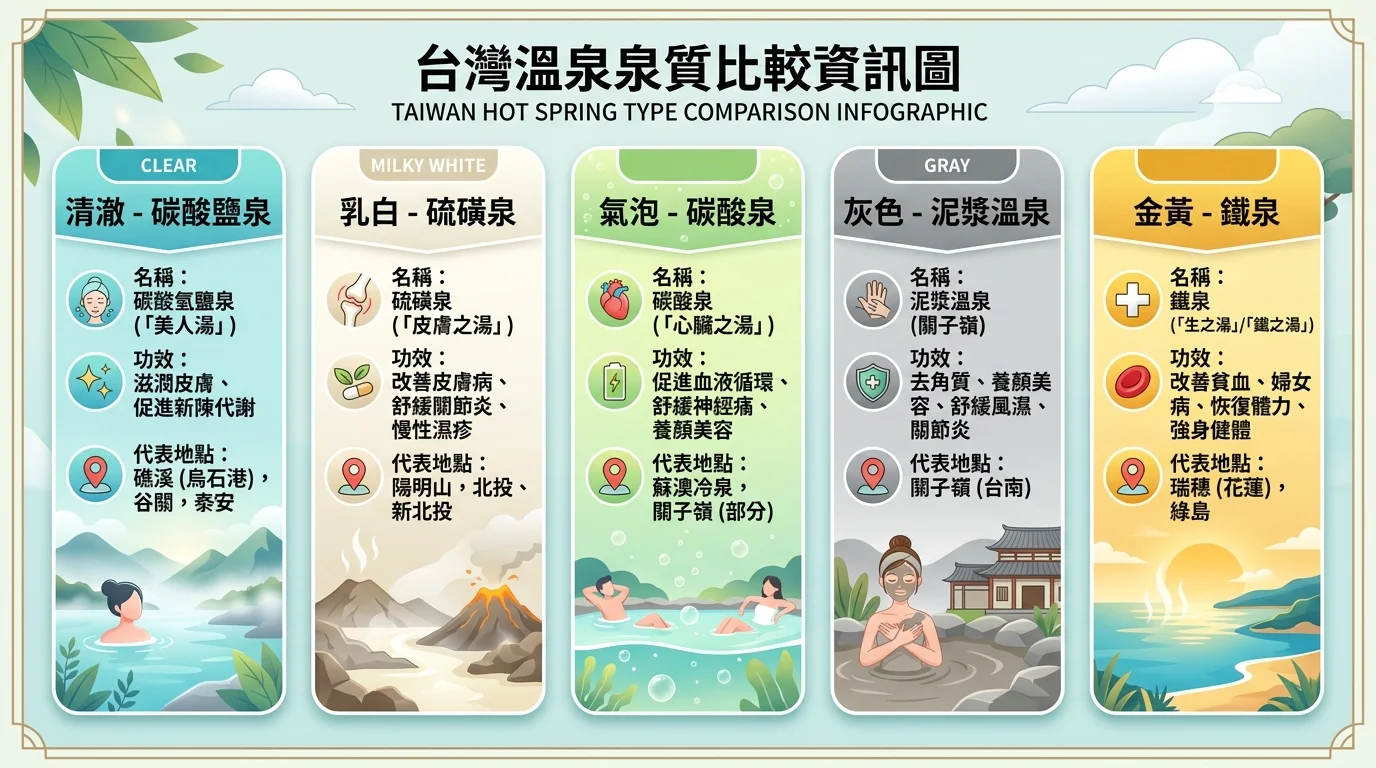
Spring Quality Comparison Table
| Spring Type | Appearance | Smell | Benefits | Representative Locations | Irritation Level |
|---|---|---|---|---|---|
| Sodium bicarbonate | Clear, colorless | Odorless | Moisturizing, skin cleansing | Jiaoxi, Zhiben | Low |
| Sulfur | Milky white/greenish | Sulfur smell | Antibacterial, exfoliating | Beitou | Medium-High |
| Carbonated | Clear with bubbles | Odorless | Blood circulation | Tai'an, Sichongxi | Low |
| Mud spring | Gray mud | Mild sulfur | Moisturizing, exfoliating | Guanziling | Medium |
| Carbonate | Golden | Mild iron | Circulation, cold hands/feet | Ruisui | Low |
Taiwan's Well-Known Hot Spring Areas
Beitou Hot Spring — Taiwan's Premier Hot Spring
Beitou's history dates to 1894 when a German merchant discovered hot springs. Must-visit: Hot Spring Museum (closed for restoration from 9 November 2026 until October 2027), Thermal Valley (steaming emerald pool — spectacular).
Jiaoxi Hot Spring — Miracle of Plains Hot Spring
A flatland hot spring, rare in Taiwan. Springs emerge from underground directly in flat Jiaoxi town — no mountain climbing needed.
Guanziling Hot Spring — A Mud Spring Rare in Taiwan
Guanziling is a mud hot spring rare in Taiwan, and back in the Japanese colonial era it already ranked alongside Beitou, Yangmingshan, and Sichongxi as one of the four great hot springs. The nearby "Water Fire Cave" natural phenomenon is a must-see.
Zhiben Hot Spring — Eastern Taiwan's Hot Spring Homeland
Sodium bicarbonate spring, clear and odorless. Zhiben Forest Recreation Area and Baiyu Waterfall are great additions to the itinerary.
Best Time to Soak? Taiwan Hot Spring Season Events
Autumn-Winter Hot Spring Season
October through February is peak hot spring season.
| Event | Time | Location | Highlights |
|---|---|---|---|
| Guanziling Hot Spring Food Festival | Oct-Nov | Guanziling | Mud spring + local cuisine |
| Sichongxi Hot Spring Season | November to early March | Sichongxi | Romantic light displays, winter only |
| Hualien Pacific Hot Spring Season | Oct-Nov (17 Oct - 15 Nov in 2026) | Ruisui, Antong | Themed light displays, light-and-firework shows, accommodation offers |
Hot Spring Season Soaking!
Autumn and winter are prime soaking season. Cool Price Travel vouchers cover the stay, with breakfast included.
礁溪長榮鳳凰酒店 voucher from NT$6,800 · Breakfast + yukata experience + room upgrade → View plan
Post-Soak Strolls: Hot Spring Streets & Old Streets
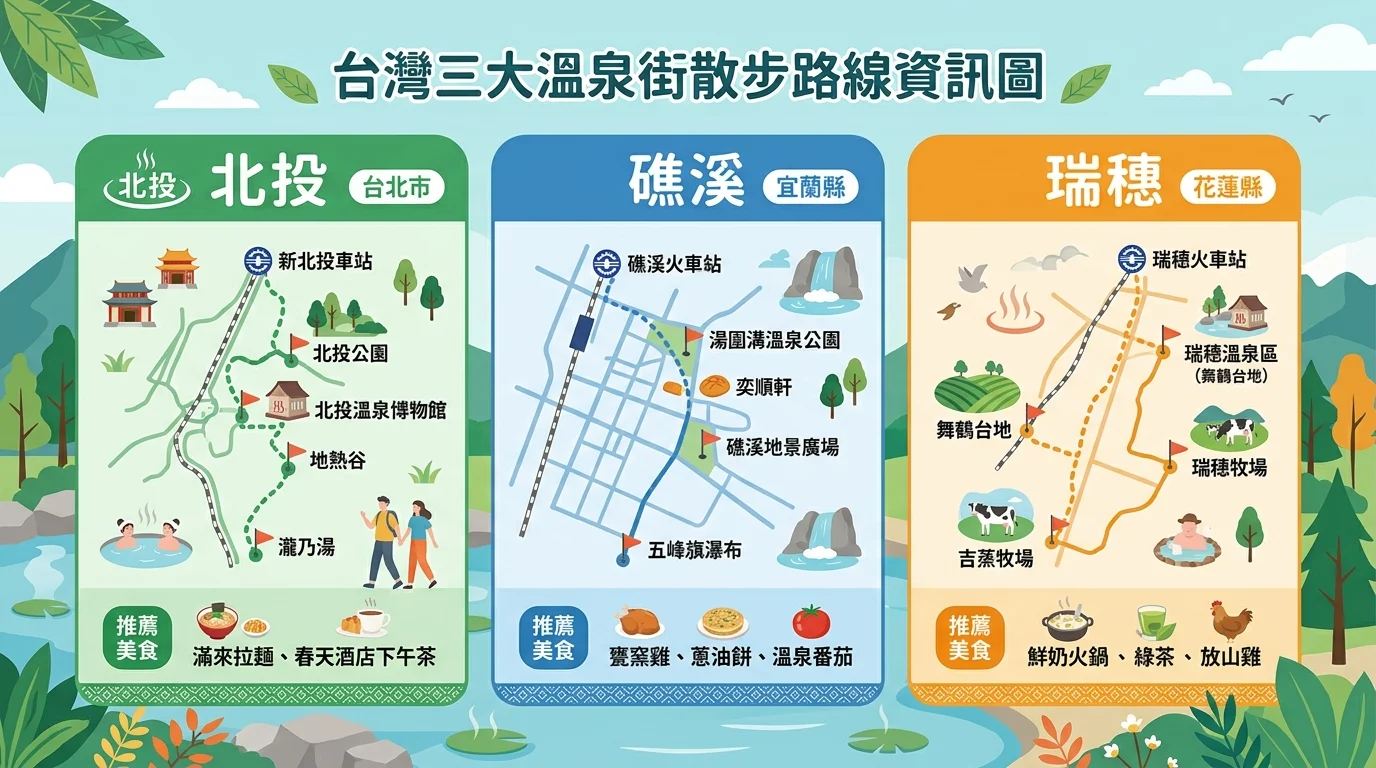
Beitou Hot Spring Street Walking Route
From Xinbeitou MRT station along Zhongshan Road to Thermal Valley — about 1.5 hours. Route: Hot Spring Museum (free; closed for restoration from 9 November 2026 until October 2027) → Plum Garden → Puji Temple → Thermal Valley.
Jiaoxi Hot Spring Street Food Guide
Jiaoxi Road Section 5 concentrates hot spring hotels and food. Must-eat after soaking: scallion pancakes, steamed buns, hot spring tomatoes.
Ruisui Hot Spring Street
Relatively lesser-known but very charming. Must-buy: Ruisui fresh milk products, local pomelo, and coffee.
FAQ
Q: What hot springs does Taiwan have?
A: Taiwan has more than a hundred known hot spring sites, mainly in Beitou, Jiaoxi, Wulai, Guguan, Tai'an, Guanziling, Sichongxi, Zhiben, Ruisui, and other areas. Spring types include sodium bicarbonate, sulfur, carbonated, mud, and carbonate springs.
Q: What are Taiwan's four major hot spring areas?
A: According to the Tourism Administration, the four most renowned hot springs of the Japanese era were Beitou (Taipei, sulfur spring), Yangmingshan (Taipei), Guanziling (Tainan, mud spring), and Sichongxi (Pingtung, carbonated spring), all with a long history.
Q: Which Taiwan counties have no hot springs?
A: Changhua, Yunlin, and other counties on the Chianan Plain have relatively scarce hot spring resources due to different geological conditions (thick plain strata, less volcanic activity). But most Taiwan counties have hot spring distribution.
Q: What type of spring is Zhiben Hot Spring?
A: Zhiben is sodium bicarbonate spring — clear, colorless, odorless, gentle and non-irritating, suitable for all skin types and ages.
Ready to Go After Learning About All These Hot Springs?
Cool Price Travel partners with hot spring hotels across Taiwan, vouchers starting from 80% off, valid with flexible dates.
Want more options?
Still deciding? Take a look at this 義大皇家酒店 voucher
View This DealFurther Reading
- Taiwan Hot Spring Hotel Recommendations
- Regional Hot Spring Hotel Recommendations
- Ruisui Hot Spring Complete Guide
- Hot Spring Accommodation Complete Guide
- Family Hot Spring Hotel Recommendations
References
- Tourism Administration Hot Spring Area Introduction
- Central Geological Survey Geothermal Resources Survey
- 2003 Hot Spring Act