
【2026】Europe Travel Insurance Guide: Schengen Requirements, Plan Comparison & Application Tips

Ready to fly to Europe — have you bought insurance yet? Taiwanese passport holders enter the Schengen Area visa-free and are not legally required to buy travel insurance, but medical costs in Europe are high, so we strongly recommend getting covered before you leave.
Medical costs are what really matter. Medical costs in Europe are genuinely expensive — ER visits in Europe are far from cheap, not to mention hospitalization or emergency medical transfers. This article helps you understand Schengen insurance hard requirements, compares what 2026 plans cover, and walks you through the 3 steps to get insured in 10 minutes before departure.
TL;DR: For Schengen countries in Europe, minimum medical coverage of 30,000 euros (approximately NT$1.07–1.08 million at current exchange rates) is a Schengen visa requirement; Taiwanese passport holders enter visa-free and are not legally required to buy insurance, but it is strongly recommended. Premiums depend on age, trip length and coverage — check each company's official online quote. We recommend increasing medical coverage to NT$2 million+ (higher for Northern Europe and Switzerland), and adding flight delay and lost luggage coverage. Complete the application in 3 steps using an online comparison platform.
The €30,000 Requirement Applies to Schengen Visas — Taiwanese Passports Are Visa-Free, So It Is Strongly Advised Rather Than Mandatory
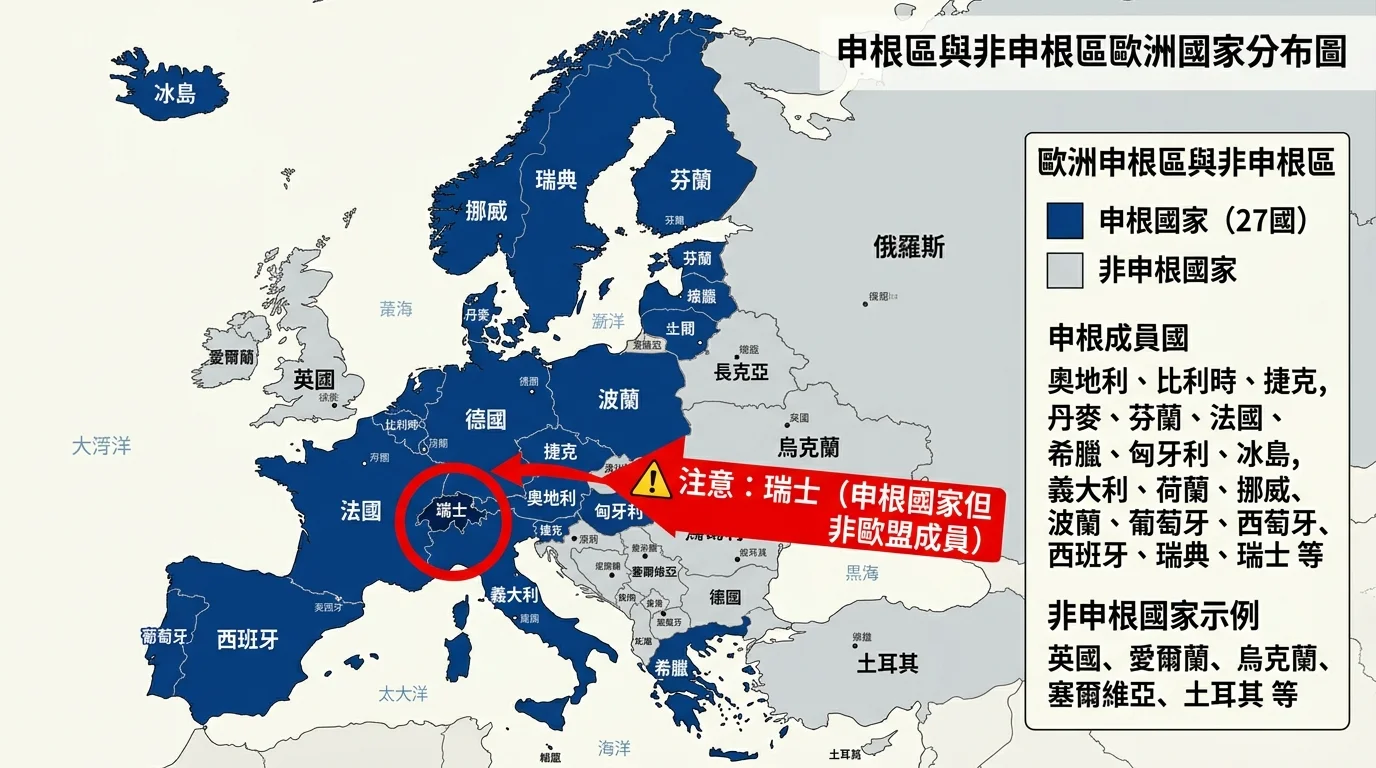
The Schengen Zone currently comprises 29 countries (Bulgaria and Romania became full members on 1 January 2025), from France and Germany to Italy and Spain.
The point most guides get wrong: the "at least €30,000 of medical cover" rule is a document requirement for applying for a Schengen visa. Taiwanese passport holders get 90 days visa-free and do not apply for a Schengen visa, so that rule does not legally apply to them — Taiwan's Ministry of Foreign Affairs and the European offices in Taipei say the same thing: not mandatory, but strongly recommended.
So why buy it anyway? European medical costs are genuinely high, and border officers may still ask visa-free arrivals to show they have adequate means; an insurance certificate is the easiest document to produce.
Schengen Visa Insurance Requirements (Coverage, Duration, Scope)
Three mandatory conditions for Schengen insurance:
- Medical coverage of at least 30,000 euros (approximately NT$1.07–1.08 million at current exchange rates)
- Must cover medical expenses, emergency medical evacuation, and repatriation of remains — all three items
- Insurance validity must span the entire stay — we recommend adding 1-2 extra days before and after
These three are the visa application standard. Visa-free Taiwanese travellers do not file an application, but using the same standard is the simplest way to pick a policy. Border officers may still ask to see proof of insurance, so it is worth carrying.
What About the UK? (Note: Switzerland is in Schengen)
This is where it gets confusing. The UK was never a member of the Schengen Zone (Brexit has nothing to do with it), so there's no Schengen insurance requirement. However, Switzerland, while not an EU member, is part of the Schengen Zone — so traveling to Switzerland still requires meeting Schengen insurance standards.
Regardless of which European country you're visiting, insurance is strongly recommended. Medical costs across Europe are generally much higher than in Taiwan — a single ER visit alone can cost quite a lot. Even in non-Schengen UK, going without insurance is a risk.
How to Choose 2026 Europe Travel Insurance Plans?
Different insurance companies' European plans vary significantly in price and coverage. Below is a comparison of what several insurers' European plans cover.
Property Insurance Company European Plan Overview
| Insurance Company | 10-Day Premium | Medical Coverage | Flight Delay | Lost Luggage | High-Risk Activities |
|---|---|---|---|---|---|
| Cathay Century | Check official quote | NT$2-3 million | Covers delays from 4 hrs | Yes | Requires add-on |
| Fubon Insurance | Check official quote | NT$1.5-2 million | Covers delays from 6 hrs | Yes | Requires add-on |
| Shin Kong Insurance | Check official quote | NT$2-3 million | Covers delays from 4 hrs | Yes | Some plans include |
| MSIG Mingtai | Check official quote | NT$1.5-2 million | Covers delays from 6 hrs | Some plans | Requires add-on |
Coverage amounts and claim thresholds in the table are an overview. Actual premiums and terms vary by age and specifics — check each company's official site before purchasing.
Premium Comparison: How Much for a 10-Day European Trip?
Travel insurance premiums for a 10-day European trip vary widely by age and plan. The differences mainly come from:
- Coverage scope: Basic medical only vs comprehensive (medical + accident + delay + luggage + cancellation)
- Medical coverage amount: NT$1 million vs NT$3 million — significant difference
- Flight delay threshold: 4 hours vs 6 hours — the former costs slightly more but is more practical
Actual premiums depend on each company's official online quote — enter your age, trip length and coverage to compare the differences.
Dcard User Europe Travel Insurance Reviews
Summarizing Europe insurance discussions from Dcard and PTT travel forums, here are common takeaways:
- Fastest claims: Cathay and Fubon online applications — with complete documents, paid within 10-15 days
- Pay attention to flight delay claim thresholds — long-haul European flights are delayed more often than you'd think
- Others complained that certain companies required excessive documentation, going back and forth for nearly 2 months
Bottom line: don't just look at premiums — claims speed and service attitude matter too.
Want a more comprehensive insurance comparison across countries? → Complete Travel Insurance Guide
What to Watch for When Choosing Europe Travel Insurance?
Meeting Schengen requirements is just the minimum. To find a plan that truly fits, pay attention to these key points.
How Much Medical Coverage Is Enough?
The Schengen visa's €30,000 works out to about NT$1.07–1.08 million at current exchange rates, so coverage needs to be at least NT$1.1 million — and we recommend going higher:
- General European countries: NT$1.5-2 million is sufficient
- Northern Europe (Norway, Sweden, Denmark): Higher cost of living — NT$2 million+ recommended
- Switzerland: Most expensive healthcare in Europe — NT$2-3 million recommended
A bit more coverage doesn't cost much extra in premiums, but if you need it, the difference could be tens of thousands.
Flight Delay & Lost Luggage Coverage Comparison
Long-haul European flights have a higher delay probability than short flights, especially:
- Winter (November-February) snowstorms causing cancellations or delays
- Summer peak season airport congestion
- Itineraries requiring connections within Europe
We recommend choosing plans with accommodation and meal compensation for delays. Lost luggage coverage is also especially important in Europe — the more connections, the higher the chance of luggage issues.
High-Risk Activity (Skiing, Hiking) Add-On Recommendations
Planning to ski in the Alps? Hike on glaciers in Iceland? These are classified as high-risk activities.
Standard travel insurance typically doesn't cover injuries from high-risk activities. If your itinerary includes skiing, mountaineering, skydiving, or diving, you'll need a separate add-on or choose a plan that includes high-risk activity coverage. Add-on costs depend on the plan, so get a quote before buying.
Something many people don't realize: different insurance companies define "high-risk activities" differently. Some classify cycling as high-risk, while others limit it to extreme sports only. Before purchasing, make sure to confirm whether your planned activities are on the exclusion list.
Plan Your Taiwan Trip Before You Go
Beyond insurance for your Europe trip, you can also start planning a domestic getaway for when you return. Cool Price Travel hotel vouchers across Taiwan start from 20% of original price, valid with flexible dates after purchase.
👉 Great Value Getaway | Hotels Across Taiwan from 20% Off
How to Apply for Europe Travel Insurance? 3 Steps Done
Now that you understand the rules and key points, it's time to take action. 3 steps to complete your application:
Step 1: Confirm your trip duration and destination countries Check whether your destination countries are in the Schengen Zone and the total number of trip days (insurance validity must cover the entire trip — we recommend adding 1-2 days on each end).
Step 2: Use online comparison platforms to compare multiple providers Insurance comparison platforms like SARAcares and Finfo let you view multiple plans at once, saving time from checking one by one. Enter your destination, duration, and age to get results.
Step 3: Apply online Choose your plan and apply online. Applying 1-2 days before departure is fine — some companies even support same-day-of-departure applications. After completing your application, save the policy on your phone for easy access at border checkpoints.
Taking parents to Europe? Insurance gets more complex — don't forget → Senior Travel Insurance Guide

Europe Travel Insurance FAQ
Q: How much coverage is needed for Schengen insurance?
A: €30,000 (approximately NT$1.07–1.08 million at current exchange rates), covering medical expenses, emergency medical evacuation and repatriation of remains, is the document requirement for a Schengen visa. Taiwanese passport holders enter visa-free and never file that application, so it is not legally mandatory — but using the same standard is the simplest way to choose a policy. We recommend actually purchasing NT$1.5-2 million for more peace of mind, especially for high-cost-of-living countries like Northern Europe or Switzerland.
Q: Do I need insurance for non-Schengen European countries?
A: Non-Schengen countries (like the UK) don't have a mandatory requirement, but European medical costs are generally very high — the cost of a single ER visit alone can be substantial. We strongly recommend travel insurance regardless of which European country you're visiting.
Q: Is credit card travel insurance sufficient for Europe?
A: Most credit card travel insurance has low coverage limits that may not meet Schengen requirements (€30,000, about NT$1.07–1.08 million). Activation conditions are also typically restrictive (must purchase full-fare tickets with the card, etc.). Consider it a bonus — don't rely on it as your only coverage. Purchasing a separate comprehensive plan is safer.
Q: When's the best time to buy Europe travel insurance?
A: We recommend applying 1-2 days before departure — some companies support same-day applications. However, if you want trip cancellation coverage, apply as early as possible after paying for your flights or tour and before any cause for cancellation arises; some plans require purchase a set number of days before departure — check each insurer's terms. After completing your application, save the policy on your phone — Schengen border officers may spot-check.

Insurance Done — Save on Taiwan Stays Too
After a European trip, body and mind both need recharging. Why not plan a relaxing domestic getaway? The best thing about traveling within Taiwan is no worrying about insurance, language barriers, or jet lag — traveling with kids is easy too.
Relax After Your Europe Trip
Want a quick getaway after returning from Europe? Cool Price Travel's half-board plans let the whole family relax without breaking the bank. Vouchers valid with flexible dates — book when you're ready for maximum flexibility.
👉 Half-Board Plan | Best Value Accommodation with Meals
Want more options?
- Half-Board Plan | Best Value Accommodation with Meals
- Great Value Getaway | Hotels Across Taiwan from 20% Off
Further Reading
- Complete Travel Insurance Guide
- Senior Travel Insurance Guide
- Credit Card Hotel Deals Guide
- Hotel Booking Apps & Money-Saving Tools
References
- EU Schengen Visa Insurance Requirements
- Tourism Administration, MOTC — Travel Industry Management Regulations
- Financial Supervisory Commission — Travel Insurance Regulations