
2026 Budget Travel Guide | See More, Spend Less
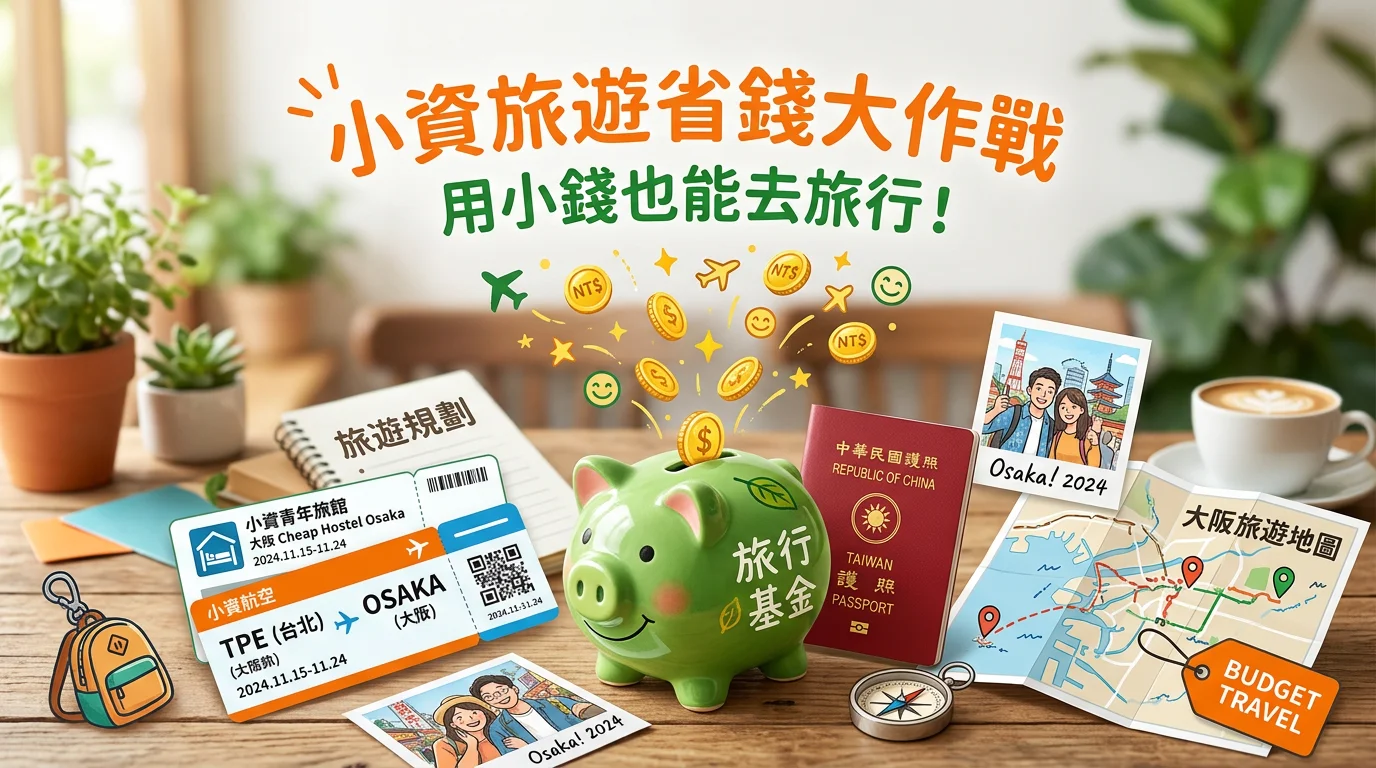
Your paycheck is what it is, but your desire to travel shouldn't suffer. It's not that you don't want to travel — you see the hotel prices and quietly close the tab.
This article isn't telling you not to travel. On the contrary, it teaches you how to spend the least and get the best quality. Our team tested every savings method out there — from hotel e-vouchers to credit card perks — and compiled only what actually works.
Budget travelers' hotel savings secrets inside, plus exclusive links to hotels starting at 80% off
TL;DR: The core of budget travel savings is accommodation. Hotel e-vouchers are 20-50% cheaper than OTAs, and pairing with weekday travel saves even more. For international trips, consider Thailand and Japan during off-season. Credit card cashback and e-vouchers can be stacked — using both together is the smartest move.
Save on Accommodation, Save the Most
In 2025, domestic tourism spending reached a record NT$564.3 billion (Tourism Administration, 2025 Survey of Travel by R.O.C. Citizens, 2026), with accommodation and dining as the largest expenditure. In 2025, the average hotel room rate across Taiwan was NT$2,984 (Tourism Bureau) — more vacancies and lower prices on weekdays. In 2024, 16.85 million outbound trips were made, with total spending reaching NT$1.0191 trillion — the first time it has passed NT$1 trillion (UDN, 2026).
How to Save on Accommodation?
Many people spend hours comparing flights and restaurants but overlook that accommodation is the key to savings.
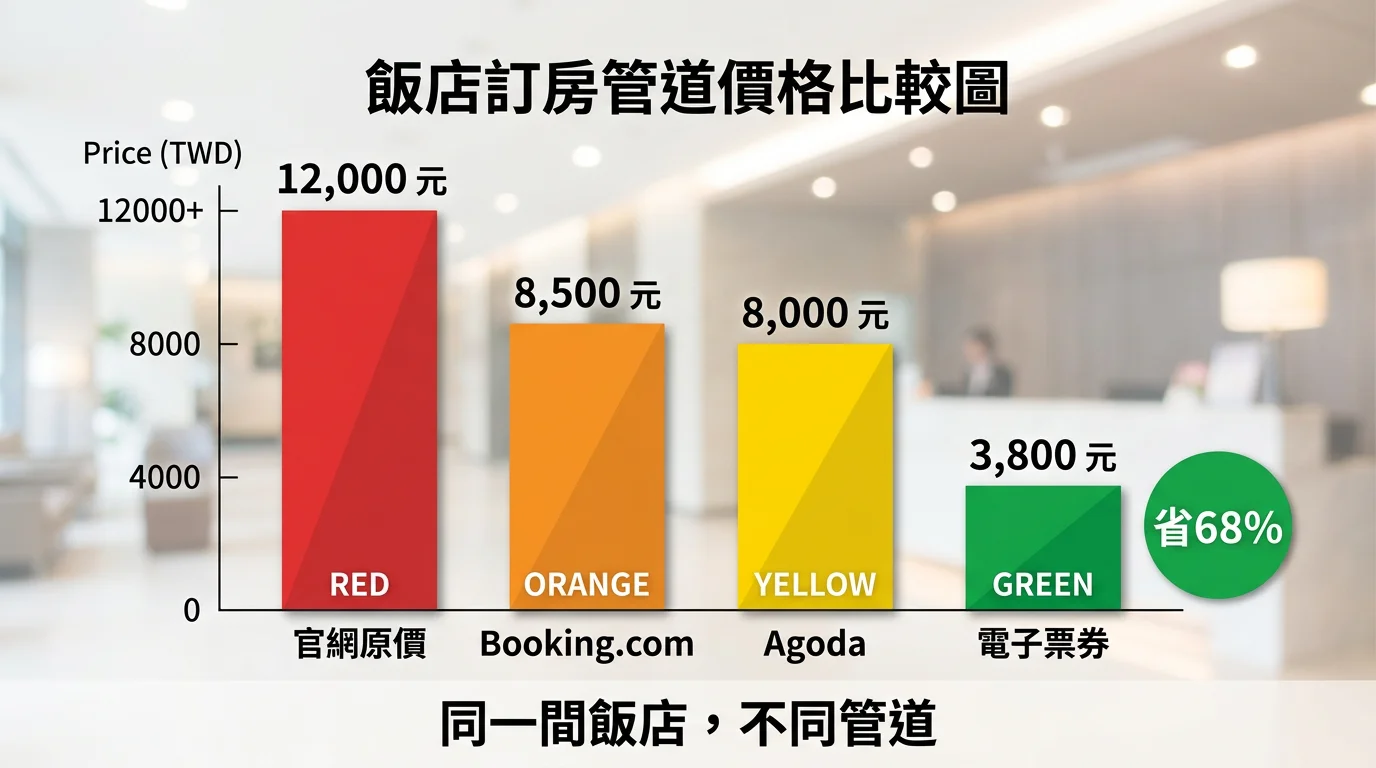
The same hotel can have price differences of several thousand NT dollars across different booking channels. This is not a joke.
The point isn't staying at the cheapest place — it's getting the cheapest price at a good place. The cheapest hostel doesn't mean savings if you sleep badly and have no energy to enjoy the next day — that's the real waste.
Hotel E-Vouchers vs. Direct Booking — How Big Is the Difference?
E-vouchers are bulk-sold discounted accommodation certificates, priced much lower than OTA platforms.
For the same hotel, prices on the official website, OTAs and e-vouchers can differ a lot — the most accurate way is to compare live prices from several channels side by side before you book.
E-vouchers have flexible booking dates, with no fear of itinerary changes. But honestly, there are downsides — you have to fill in a booking form and wait for Cool Price Travel to book the hotel for you — it's only confirmed once you receive the booking confirmation email — and popular dates (Saturdays, holidays) may be fully booked. But the money saved is absolutely worth five minutes of form-filling.
👉 Hotel vouchers starting at 80% off across Taiwan, valid with flexible dates →
How to Travel Taiwan on a Budget?
Weekday Travel: E-Vouchers + Flexible Booking Is Smartest
For the same hotel, weekdays are usually cheaper than weekends, with Saturday the most expensive.
The beauty of e-vouchers is booking dates after purchase. Go on a weekday if you want, avoid crowds if you want — total flexibility.
The budget traveler's golden combo: E-vouchers + weekday travel = maximum savings.
Budget Hostels, Guesthouses, and Hotel Voucher Comparison
| Accommodation Type | Cost Per Night | Pros | Cons |
|---|---|---|---|
| Hostel | Varies by area and date | Cheapest, social atmosphere | Poor privacy, basic facilities |
| Guesthouse | Varies by area and date | Homey feel | Inconsistent quality |
| Hotel voucher | Depends on the voucher plan | Hotel quality, full amenities | Booking form required; wait for confirmation |
See that? With hotel e-vouchers, you can stay at a hotel for the price of a guesthouse. With the same budget, would you rather stay at a guesthouse of uncertain quality, or a hotel with a pool and breakfast?
👉 Accommodation with breakfast and dinner — budget travelers' favorite one-night-two-meals packages →
How to Find Travel Subsidies and Promotions
- Various city governments periodically launch travel subsidy programs; amounts and conditions are subject to each program's official announcement
- Tourism Administration's Taiwan Stay portal, which links to the domestic travel subsidy application system, is the most up-to-date source
- Join travel groups and LINE chats for first-hand deal information
- Dcard Travel and PTT Travel boards frequently feature user-shared deals
A reminder: government subsidies usually have limited spots and sometimes cumbersome application processes. In contrast, e-voucher discounts are fixed — no need to compete for slots.
Where Should Budget Travelers Go Internationally?
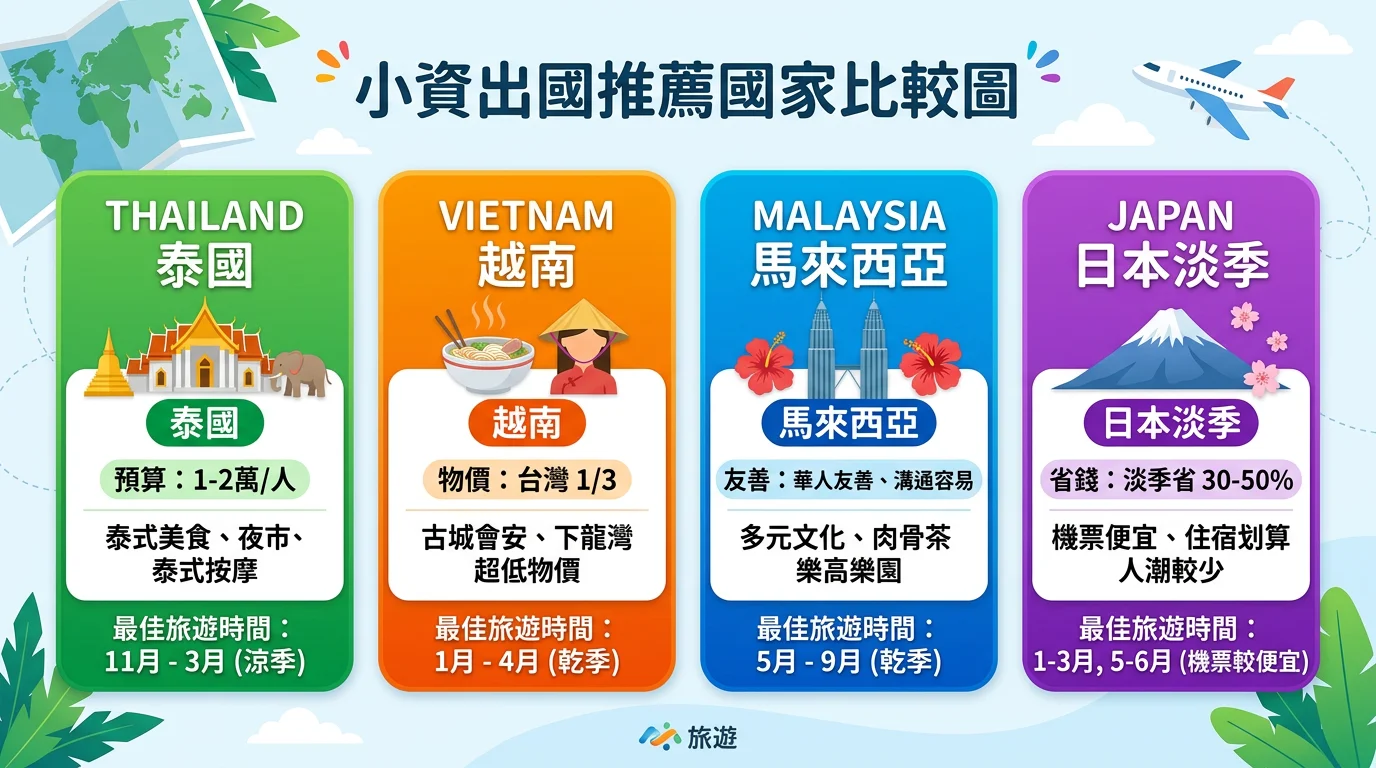
Best Budget-Friendly Countries: Big Experiences, Small Price
- Thailand: Food, massages, and islands galore. Bangkok has plenty of hostels at friendly prices
- Vietnam: Low prices. Local street food in Hanoi and Ho Chi Minh City is very affordable
- Malaysia: Kuala Lumpur and Penang have large Chinese communities — easy communication and incredible food
- Japan off-season: January-March and June flights and hotels are usually cheaper than peak season. Winter onsen in Tohoku, summer escapes in Hokkaido
Budget International Travel: Flight and Accommodation Tips
Flights: Use Google Flights to track prices and set alerts. Subscribe to budget airline (Tigerair, Peach, Scoot) newsletters — promotions often bring special fares.
Accommodation: In Japan, try capsule hotels or business hotels at relatively friendly prices. Southeast Asian hostels exceed expectations — many have pools and shared kitchens.
Dining: Eat at local markets — usually cheaper than tourist areas. Thai street food is also very affordable.
Are Credit Card Travel Perks Actually Useful?
2026 Best Travel Credit Cards (Dcard User Favorites)
Top travel credit card combos recommended on Dcard:
- Overseas spending: Federal LINE Points Card (LINE POINTS rewards, with extra rates for specific countries and campaign periods), E.SUN U Bear (up to 1% on general overseas spending — the 3% figure belongs to its online-shopping tier, a different column), Fubon J Card (travel rewards in Japan, Korea and Thailand)
- Domestic travel cashback: Cathay CUBE (the benefit plan must be switched on the day you spend; its Travel plan covers designated airlines, travel agencies and booking platforms)
Card rewards change every quarter and usually come with registration thresholds and limited campaign windows. Treat the above as direction only — check the issuing bank's current terms before deciding, not the numbers in an article.
- Included travel insurance: Many credit cards include complimentary travel insurance; coverage varies by card, so check before you leave
One thing to note: credit card cashback looks great, but it's calculated as a small fraction of what you spend, while e-vouchers lower the room rate directly — you only know which saves more by running the numbers on actual prices.
Credit Card Booking vs. E-Vouchers — Which Saves More?
The smartest approach is use both: Buy at the cheapest price with e-vouchers, then pay with a cashback credit card. You get the voucher discount + credit card cashback — double savings.
The Ultimate Budget Savings Formula
E-voucher discount + weekday travel + credit card cashback = spend the least for the best hotel. No waiting for sales, no hunting for promo codes — this method works anytime.
👉 Skip the credit card deals — hotel vouchers at 80% off beat any cashback →
Is Solo Travel Safe for Women on a Budget?
Solo Stay Safety Tips
Safety is the top priority when traveling alone. Keep these in mind when choosing accommodation:
- Choose places with access control systems and 24-hour front desk staff
- Avoid overly remote locations — convenient transportation is most important
- Share your itinerary and accommodation details with family or friends before departure
- Always deadbolt your room door and don't open it for strangers
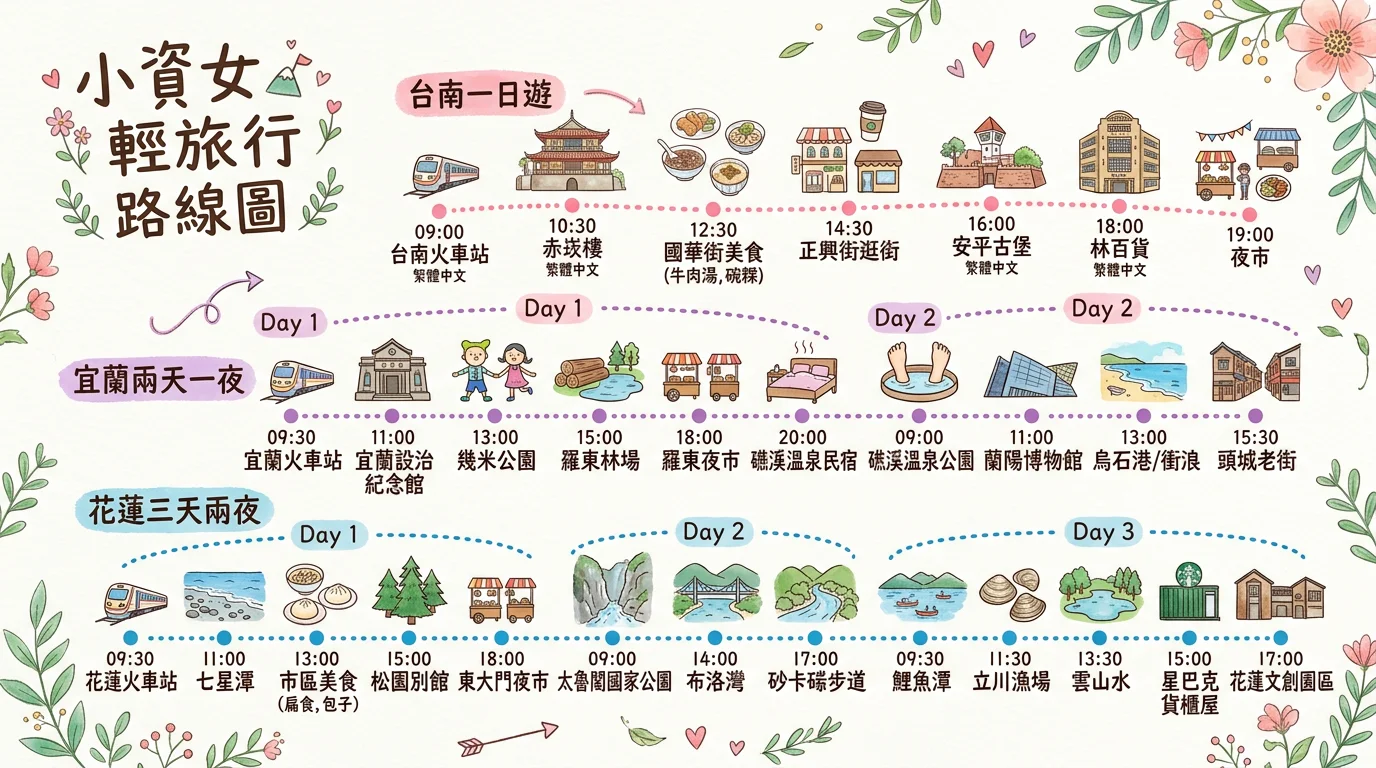
Light Travel Routes for Budget-Conscious Women
- Tainan one-day artsy walk: Anping Old Street → Shennong Street → Blueprint Cultural & Creative Park → Garden Night Market
- Yilan two-day-one-night healing trip: Jimmy Park → Jiaosi Hot Springs → Luodong Night Market
- Hualien three-day-two-night nature trip: Taroko Gorge → Qixingtan Beach → Dongdamen Night Market
Before you plan around Taroko: many trails still haven't reopened since the 3 April 2024 earthquake. The Shakadang Trail is still listed as closed on the park's site, and the Swallow Grotto Trail is also listed as closed. The Dekalun Trail is listed as open on the park's site (1.3 km one way, returning the same way), the Lyushui Trail is partly open (start from the Lyushui end and turn back about 250 m in, at the small suspension bridge), and the Jiuqudong Trail is listed as closed on the park's site. Check the Taroko National Park site before you go.
FAQ
Q: How much does a budget trip cost?
A: The cost mostly comes down to accommodation and transport. For domestic trips, using e-vouchers for accommodation and splitting a double room saves the most, and one-night-two-meals packages even cover dining. For international trips, flights and hotels fluctuate a lot by season, so checking live prices with comparison tools before you go is most accurate.
Q: Where's the best value for budget international travel?
A: For value, Thailand and Vietnam are Asia's best deals. Local prices in both are lower than in Taiwan. Japan during the January-March and June off-season is also relatively affordable. Malaysia's cost of living is similar to Thailand's but with more Chinese speakers for easier communication.
Q: How big is the difference between hotel e-vouchers and direct booking?
A: The difference varies by hotel and date — the most accurate way is to compare live prices from the official website, OTAs and e-vouchers side by side before you book. The downside is having to fill in a booking form and wait for confirmation, and popular dates may be fully booked, but the savings far outweigh this minor inconvenience.
Can Budget Travelers Really Have a Good Time?
Many people think travel is a "luxury for the wealthy" — time to change that mindset. Travel quality isn't about how much you spend but whether you chose the right approach. E-vouchers lower the threshold for five-star hotels to guesthouse prices, and weekday travel lets you avoid crowds for better service. A tight budget isn't a limitation — it's motivation to spend smarter.
Want to save even more? See → Complete Backpacker Accommodation Guide
Budget-conscious couples can stay at great hotels too → Couples Accommodation Picks
More accommodation recommendations for different traveler types? Back to → 2026 Complete Family Travel Guide
Budget Travelers Can Stay at Great Hotels Too
Budget travelers can absolutely stay great! Over 100 packages across Taiwan are waiting →
👉 Great Value Getaway | Hotels Starting from 80% Off
Want more options?
Further Reading
- 2026 Complete Family Travel Guide
- Complete Backpacker Accommodation Guide
- Couples Accommodation Picks
References
- Tourism Administration Domestic Travel Subsidy Application System, 2026
- Google Flights Price Comparison, 2026